
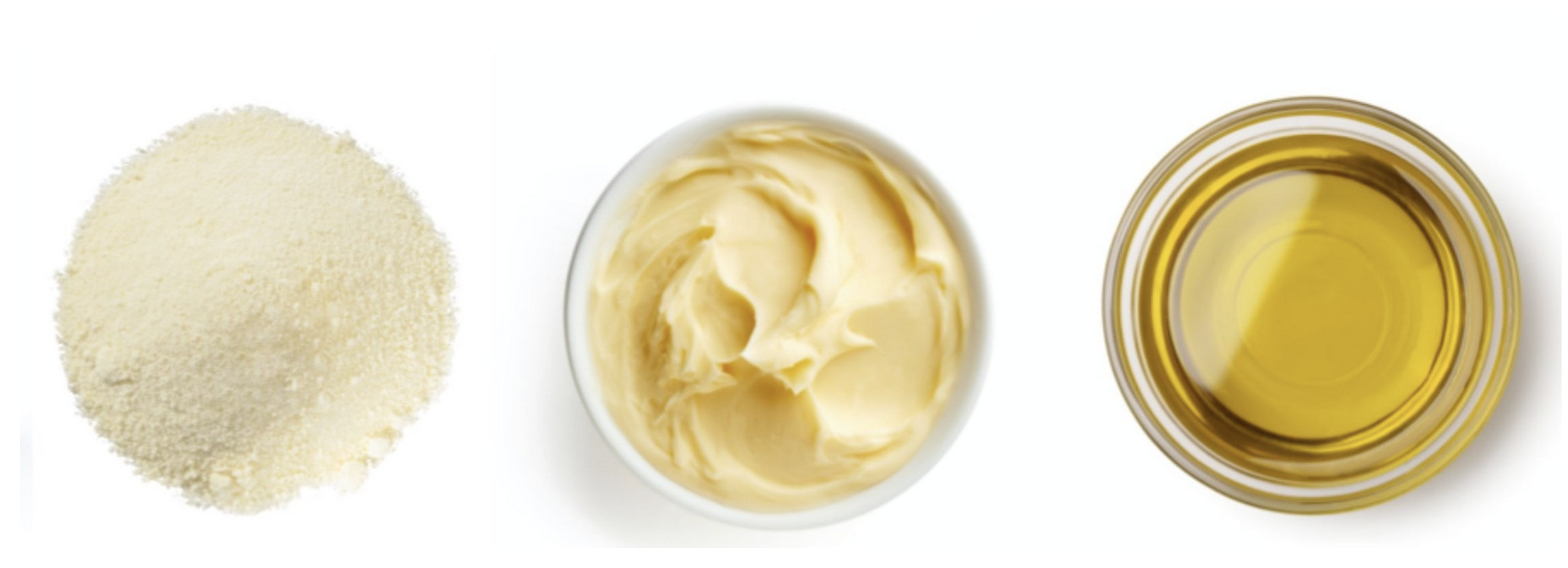
We’ve talked about cocoa butter percentage and how it affects the texture of your fillings.
But let’s look at the other fats we can use in our ganache recipes, shall we?
In the world of chocolate, fats include everything from cocoa butter, oil, butter, coconut fat, and even lard (basically, any ingredient that contains more than 50% fat).
Butter and cacao butter are our go-to ganache fats. However, you can use other options to adjust the texture and enhance the flavor of your ganache.
The Melting point of fats in ganache
First, we need to understand that the melting point of fats determines why some are solid, like cocoa butter, and others are liquid, like oils.
The melting point is the temperature at which a fat changes from a solid to a liquid state.
Saturated fats (like butter, coconut oil, or cocoa butter) have a higher melting point: they need higher temperatures to be 100% melted and keep some solid fat at room temperature.
Oils, on the contrary, have a very low melting point: they need lower temperatures to be 100% melted.
The melting points of commonly used fats in chocolate-making
• Fresh Butter (82-84% Fat): 28°C-35°C
• Cacao Butter: 32°C-35°C
• Fractionated Coconut Oil (is always liquid): 4°C
• Olive Oil: -6°C
• Peanut Oil: 3°C
What does this mean?
If you are at room temperature (18°C-20°C), some of the cacao butter you use won’t be melted entirely (because it only fully melts when you warm it above 35°C).
So, when you use cocoa butter in your fillings, it gives them far more structure than adding olive oil, for instance.
This is also why we add more cocoa butter to enrobed bonbon fillings. At room temperature, a higher percentage of cocoa butter is still solid, giving the ganache that firmer texture we need to cut and enrobe it.
A small texture and flavor tip when working with fats
If you think about it, using oils and fats also means that you can play with the mouthfeel of your fillings.
If you want to know what effect a fat will have on the texture of your filling, start by picturing the fat you want to use at room temperature.
Is it creamy but still holds its shape (like butter), is it firmer (like cocoa butter), or is it completely liquid (like olive oil)?
Now that you have your answer, this is the texture the fat you choose will impart to the final texture of your ganache.
For example, adding a touch of olive oil or peanut oil to your molded bonbon filling can give you that softer, smoother mouthfeel you’re looking for.
How much fat should your ganache fillings have?
Now that you know more about fats and how you can use them to adapt the mouthfeel, flavor, and texture of your ganache, I want to share with you the fat percentage range you should always keep in mind.
1. If you’re making a ganache for a molded bonbon: Cocoa butter (12%-18%) | Dairy fat or oil (8%-20%)
2. If you’re making a ganache for an enrobed bonbon: Cocoa butter (19%-30%) | Dairy fat or oil (5%-15%)
Now you can get all those rare oils you’ve always wanted to try but didn’t know how to use, and make unique fillings with them.
-Melissa
P.S.: Using oils is also a great way to enhance the flavors of your ganache (i.e., adding some peanut or fractionated coconut oil to your peanut or coconut ganache).