
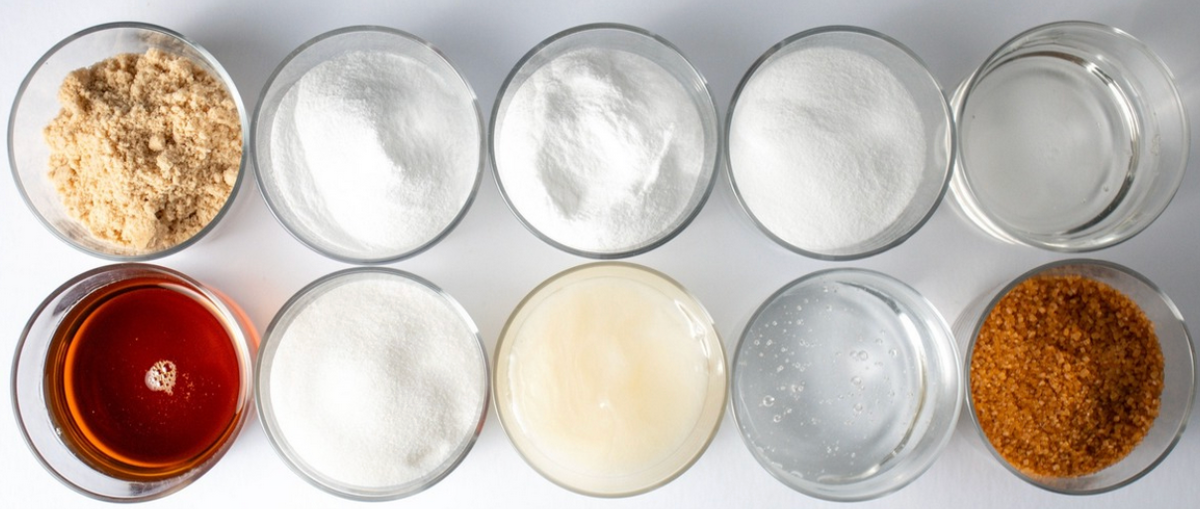
If you skim my recipes, you will notice I never use just one type of sugar to make my bonbon ganaches and fillings.
Sometimes, we think of sugar as something we add to recipes for sweetness rather than function.
But when you mix sugars in a recipe, you are directly determining their texture, shelf life, level of sweetness, crystallization capacities, and taste profile.
Each sugar is a potent additive that can improve your recipes in many ways!
So by using a combination of sugars like sucrose (a.k.a. granulated sugar), invert sugar, dextrose, sorbitol powder, and glucose syrup in a recipe (or as I like to call it, my sugar “cocktail”), your fillings will be more stable, smooth, and flavorful.
So, what role does each one of them play in fillings?
Granulated Sugar (A.K.A. Sucrose)
Granulated sugar needs little introduction. It’s the type of sugar we have in our pantry and use in everyday recipes and baking. But keep in mind that it always tries to recrystallize and return to its granular, crystalline form. This could be essential in some recipes, like marzipan, or catastrophic in others, like caramel and ganache.
Imagine biting into a sugar granule when you try your bonbon. Pretty terrible, right? The solution is simple, though. We can combine sucrose with other non-crystallizing sugars like glucose syrup (see below).
Another key point is that, in Pastry, we use a scale to determine how sweet a sugar or sweetener is. Sucrose is our benchmark with a sweetening power of 100.
You can tell how sweet a sugar is by comparing it to the value of sucrose; if it’s higher than 100, it’s sweeter. If it’s lower, it’s less sweet. Some of the alternatives I mention below have a lower SP and can help you balance the sweetness of your products.
But that’s not all. Sucrose is an extremely useful food preservative due to its hygroscopic properties (it retains water) and its Aw (Water Activity) reducing capacities, which limit the growth of bacteria in confections and keep your products moist for longer.
However, there are stronger food preservative sugars, like our next option: Sorbitol.
Sorbitol Powder
Technically, sorbitol isn’t a sugar, but a sugar alcohol or “polyol.”
It’s great for binding free water. Water in foodstuff can be either bound or free. Free water allows microorganisms to grow freely, reproduce, and reduce the shelf life of your products, which is why we want to reduce it.
All sugars reduce free water and preserve food better, but sorbitol is the best one by far. If you combine sorbitol with sucrose, your products will be in top shape for longer.
Sorbitol also has a lower sweetening power than other sugars: Just 55.
It doesn’t caramelize.
Dextrose
Dextrose is a versatile sugar. Right after sorbitol, it’s the second sugar with the highest free water-binding capacity.
Also, its sweetening power is lower than sucrose or inverted sugar (65-75), helping reduce sweetness in recipes, much like sorbitol.
Glucose Syrup
Glucose syrup, in turn, gives your ganache elasticity.
In addition to this, glucose syrup (as well as inverted sugar) is considered a “non-crystallizing sugar.”
This means that it will help prevent the recrystallization of granulated sugar in your recipes, keeping their texture over time.
Its sweetening power is 45-65, so we mainly use it for its non-crystallizing power, as it’s not a main source of sweetness.
Invert or Inverted Sugar
Inverted sugar is known for being highly “hygroscopic.” This means it retains moisture for longer, preventing fillings from drying.
This is helpful in ganache fillings made with dark chocolate, which tend to dry out because of their high fiber content.
However, inverted sugar has a higher sweetening power than sucrose (125-150), so always be mindful of the total percentage you add to your recipes so they’re not overpoweringly sweet.
How Much Sugar Should Your Ganache Have?
For a well-balanced ganache, the percentage of sugar you should use is between 26% min. — 38% max.
Playing with sugars is an open invitation to adjust the texture, sweetness, and shelf life of your bonbon fillings.
I’m curious: what sugar “cocktail” do you use in your recipes?
-Melissa