
Have you noticed that in many of our guest chefs’ recipes, you find “anhydrous butter” instead of regular butter?
Let’s talk about this alternative, then. What it is, why some chocolatiers use it, and why you might want to add it to your ganache recipes (or not).
Butter is a fat, but one that contains an important amount of water: 18%. This means the remaining 82% is fat.
Anhydrous butter, however, is butter from which that water percentage has been removed (an-hydrous = no water). The fat-to-water ratio speaks for itself, as anhydrous butter can reach up to 99.9% fat and only 0.1% water.
In other words, it’s clarified butter or Ghee.
Balancing the free water in your ganache with anhydrous butter
We’ve already talked about the importance of balancing free water in ganache recipes to extend shelf life.
One of the ways you can reduce the water in your filling to an ideal 15-22% (total water content) without affecting its unctuosity is by replacing butter with anhydrous butter.
Using this alternative is also worth looking into because of clarified butter’s extended shelf life. Butter is rather fragile, requires constant refrigeration, and becomes rancid after just a couple of weeks.
Anhydrous butter, on the other hand, can sit at room temperature for up to 6 months (technically).
You may be wondering why, if anhydrous butter is so good, I never use it in my recipes. This is just a matter of personal preference.
Using one or the other doesn’t really determine your product’s quality as long as your formulation is on point. If this is an ingredient you’ve been wanting to formulate with, please do it!
Two key points to consider before using anhydrous butter in your ganache
Just a couple of tips and suggestions:
- Because it’s so low in water, if you ever use anhydrous butter, make sure your ganache recipe is well-balanced and reaches that min. 15% water content it needs to work. Otherwise, you might not get an emulsion, and the ganache will split.
- Keep in mind that anhydrous butter has a stronger “buttery” taste, and it can clash with delicate flavors. If you’re looking to make a lychee ganache, for example, anhydrous butter might not be the best canvas for such a subtle flavor. This is the main reason I stick to regular butter in my recipes—it has a more neutral flavor.
It seems this is the perfect conclusion to share with you one of Ramon Morató’s tips on anhydrous butter.
There’s no need for you to buy commercial clarified butter! In fact, making it yourself is cheaper.
Plus, you can be sure that the product is as fresh as possible.
So which one do you prefer, clarified butter or regular butter?
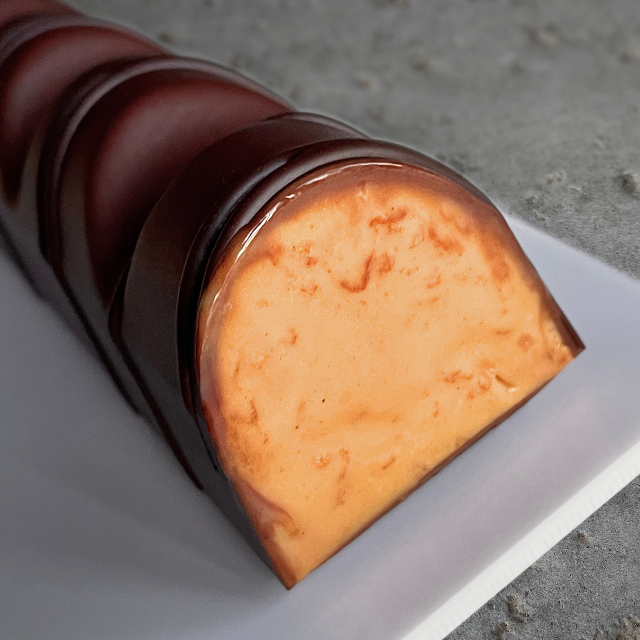
If you need some inspiration, check out Chef Raúl Bernal’s take on Kinder Bueno (Finger Bueno), where he uses anhydrous butter for the filling.