
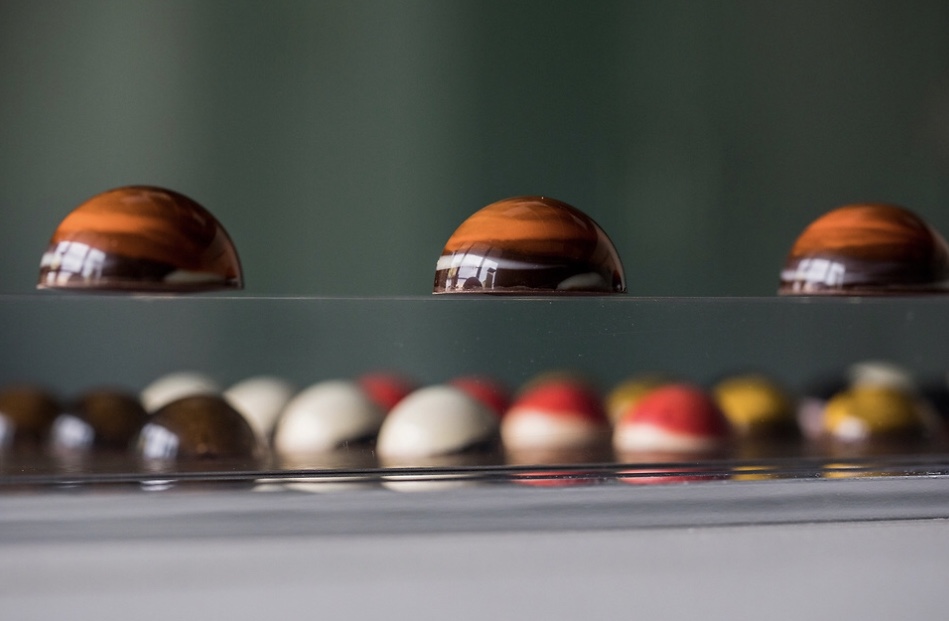
If you’re anything like me, you probably love layering fillings in your molded or enrobed chocolate bonbons.
Although I occasionally enjoy making ganache-only bonbons, I think there’s something memorable about a bonbon where different textures meld into something beautiful and cohesive.
But how do you calculate the shelf life of a bonbon that combines both water-based fillings (like ganache or compote) and fat-based fillings (crunches, dujas, giandujas, etc.)?
In this blog, I’d like to show you how easy it actually is.
But first things first.
Let’s talk a little bit about how we measure shelf life in food products, the tools we use, and the unit of measurement we use to determine the preservation of a recipe: water activity, or aw.
AW: Water Activity and Chocolate Bonbon Fillings
Water activity (aw) is a key measurement used in food science to determine the shelf life of foodstuff.
If you’re not planning to eat your bonbons the same day you make them, water activity becomes crucial to tell how long they will stay in good shape and avoid food safety issues.
Water activity is measured with a device called an aw meter.
The goal of this machine is to show you, on a scale from 0 to 1, how much free water is in your recipe. (This is also the tool I use to give you the exact shelf life of all my recipes on the school website. If you’re wondering, the brand I use is Aqualab.)
So what does free water mean?
Water in food can be either bound or free.
In simple terms, free water is the water available for microorganisms to live and reproduce, and therefore spoil your products faster.
Bound water, on the flip side, stalls the spread of these microorganisms, extending the shelf life of your filling.
Therefore, a recipe’s aw (water activity) value is crucial because it tells us how much free water it has and how long we can expect it to stay in top shape:
- The closer the water activity number of your recipe is to 1, the higher the free water content. This means a recipe with a shorter shelf life.
- The farther the water activity number of your recipe is to 1, the lower the water content. This means a shorter shelf life.
Bonbon filling water activity examples
Just to give you an idea of the types of water activity we work with in chocolate, I thought I’d share a table I include in all my classes:
| Pure water |
aw: 1
|
| Ganache |
aw: 0.68-0.70
|
| Marzipan |
aw: 0.70
|
| Hard caramel |
aw: 0.40
|
| Chocolate |
aw: 0.30
|
Now, this is how you can translate those values into your product’s shelf life:
| aw | Shelf Life / Days |
| 0.90 – 0.95 | 5 days |
| 0.86 – 0.90 | 10 days |
| 0.85 | 20 days |
| 0.83 | 30 days |
| 0.82 | 40 days |
| 0.80 | 50 days |
| 0.79 | 60 days |
| 0.78 | 70 days |
| 0.77 | 80 days |
| 0.76 | 90 days |
| 0.75 | 100 days |
| 0.74 | 120 days |
| 0.72 | 150 days |
| 0.71 | 180 days |
| 0.70 | 250 days |
| 0.60 | Over 365 days |
Based on this information, if your ganache has a shelf life of 0.76, it means you can store it at 16°C or below for 90 days.
So how do you determine the shelf life of your chocolate bonbons when they have multiple fillings?
This matter is actually very simple to settle.
In this case, the filling with the shortest shelf life will determine the overall shelf life of your bonbon.
Here’s a quick example:
If your bonbon has a compote with an AW of 0.80 (50 days of shelf life at 16°C or below), and you combine it with a sesame crunch with an AW of 0.30 (more than 365 days of shelf life!), the final shelf life of the bonbon will be 50 days.
Can’t afford an aw meter? Send me your recipes, and I’ll measure them!
The only issue with measuring the aw of your recipes is how expensive Aw meters are.
However, if you want to increase the quality, preservation, formulation, and perceived value of your bonbons, I can’t recommend getting one enough.
I know that this might not be in everyone’s realm of possibilities, so… did you know you can send me your recipes for an Aw reading?
I can replicate them in my kitchen and measure their aw value for you with my Ganache Product Lab consultation service.
If that’s something you’re interested in, you can join the school’s VIP subscription (which includes 5 recipe aw readings a year) or email me for a one-time consultation service at info@melissacoppel.com
I hope you found this information useful. Keep your recipes safe and delicious!
With love,
Melissa